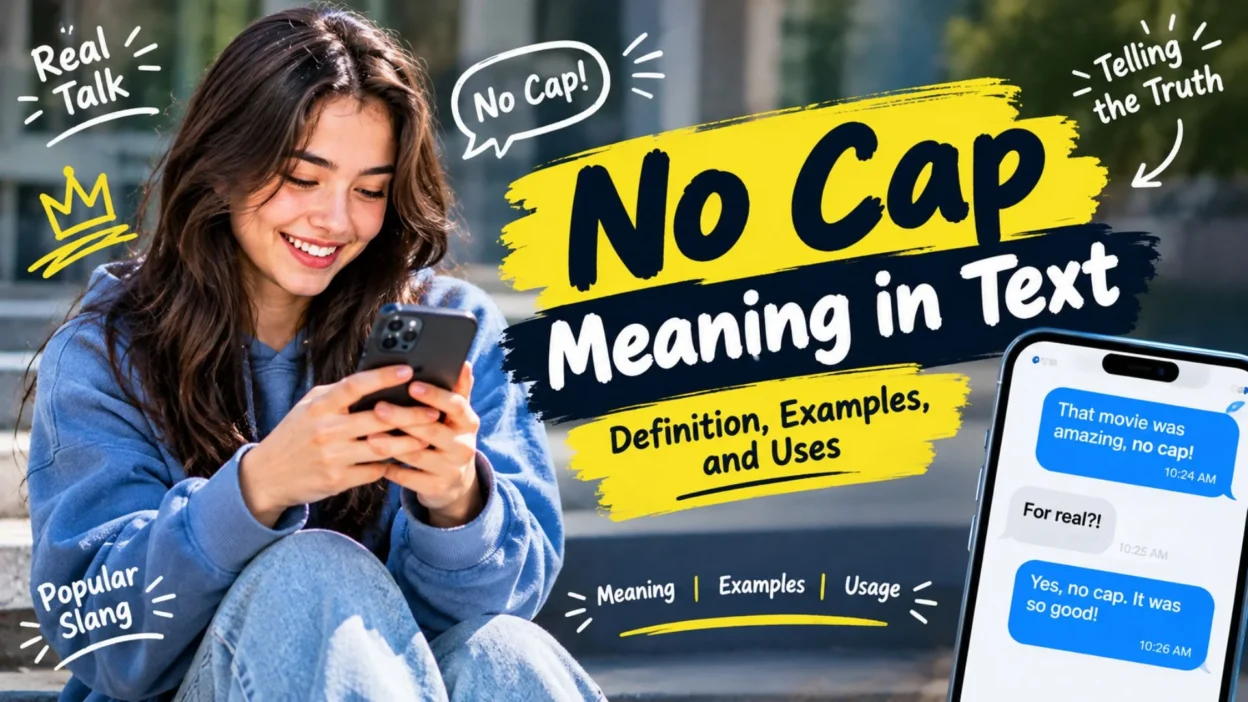
Have you ever received a text that says “No cap” and wondered what it means? This popular slang phrase appears in text messages, social media comments, memes, and everyday conversations. People use it to show that they are telling the truth or speaking honestly.
The expression is common among younger internet users. However, anyone who spends time online may come across it. Understanding the phrase can help you follow conversations and recognize when someone is being serious.
In this guide, you will learn the meaning of no cap in text messages, see real-life examples, and discover how to use it naturally. You will also learn related slang terms and common mistakes to avoid.
What Does No Cap Mean in a Text Message?
“No cap” means “no lie,” “I’m telling the truth,” or “I’m being serious.” People use it to emphasize that a statement is honest or genuine.
For example, someone might text, “That was the best movie I’ve ever watched, no cap.” They are emphasizing that they genuinely enjoyed the movie.
The word “cap” is slang for a lie or a false statement. Therefore, saying “no cap” means there is no lie involved.
Friends often use this expression when discussing their opinions, experiences, achievements, or feelings. It can also add emphasis to a funny comment.
Here are a few simple examples:
- “Your new shoes look amazing, no cap.”
- “That test was difficult, no cap.”
- “I’m exhausted today, no cap.”
- “This restaurant serves the best burgers, no cap.”
- “You are really good at basketball, no cap.”
In each example, the speaker wants others to understand that they genuinely mean what they say.
Where Did This Slang Phrase Come From?
The phrase has roots in African American Vernacular English (AAVE), where “cap” has been used as slang for lying or exaggerating. The expression became more widely recognized through hip-hop culture, music, and online conversations.
Social media platforms helped it reach a much larger audience. TikTok, Instagram, YouTube, and other online communities made the phrase familiar to people around the world.
Today, people use it in casual messages, captions, comments, and videos. Some use it seriously, while others add it to jokes for extra emphasis.
Although the expression is widely understood online, it remains informal. In professional emails or academic writing, words such as “honestly,” “truly,” or “without exaggeration” are usually more suitable.
How to Use No Cap in Text Messages
Using the phrase is simple once you understand its purpose. Add it to a sentence when you want to emphasize honesty or show that you genuinely believe something.
It can appear at the beginning or end of a message. However, placing it at the end often sounds natural in casual conversations.
To express an honest opinion:
“That restaurant has the best pizza, no cap.”
This means the person genuinely believes the pizza is excellent.
To emphasize a feeling:
“I’m so tired today, no cap.”
The sender wants to make it clear that they really feel exhausted.
To compliment someone:
“You did an amazing job on that project, no cap.”
This shows that the compliment is sincere.
To describe an experience:
“That concert was unforgettable, no cap.”
The person is emphasizing how much they enjoyed the event.
You can also use the phrase when agreeing with a friend. For instance, “No cap, you’re right about that” means you honestly agree with their point.
No Cap Examples in Everyday Conversations
The best way to understand slang is to see how people use it naturally. These examples show how the phrase fits into different texting situations.
Chat Between Friends
Alex: “Did you enjoy the school trip?”
Sam: “Yeah, it was so much fun, no cap.”
Sam is confirming that the trip was genuinely enjoyable.
Talking About Food
Mia: “How was the new burger place?”
Jordan: “Their burgers are incredible, no cap.”
Jordan is emphasizing a sincere opinion about the food.
Giving a Compliment
Taylor: “I finally finished my painting.”
Riley: “It looks beautiful, no cap!”
Riley is expressing genuine appreciation for Taylor’s work.
Discussing a Difficult Day
Chris: “How was your day?”
Jamie: “Super busy. I’m ready to sleep, no cap.”
Jamie uses the phrase to emphasize how tired they feel.
Agreeing With Someone
Ava: “That final episode was the best one.”
Noah: “No cap, I loved it too.”
Noah agrees and makes the response more emphatic.
These conversations demonstrate that the phrase can fit many casual situations. Its main purpose is to add sincerity or emphasis.
What Does Cap Mean on Its Own?
Understanding “cap” makes the full expression much easier to remember. In slang, cap generally means a lie, an exaggeration, or something that is not true.
For example, someone might say, “That’s cap!” after hearing a story they do not believe. They are suggesting that the other person is lying or exaggerating.
Consider these examples:
- “You said you met a famous actor? That’s cap!”
- “Stop capping. Tell me what really happened.”
- “There’s no cap in that story.” This means the speaker claims the story is truthful.
- “He was capping about his score.” This suggests he exaggerated or lied about his result.
The tone depends on the conversation. Friends may use these expressions playfully, but the same words can sound confrontational in a serious discussion.
Remember that slang is not proof that someone is lying. It simply communicates the speaker’s opinion about a statement.
No Cap vs. Cap: What’s the Difference?
These expressions have opposite meanings in casual internet slang.
| Expression | Meaning | Example |
|---|---|---|
| No cap | Telling the truth | “This song is great, no cap.” |
| Cap | A lie or exaggeration | “That’s cap!” |
| Capping | Lying or exaggerating | “You’re capping about that story.” |
| No lie | An honest statement | “No lie, I enjoyed the show.” |
| For real | Genuine or serious | “That was impressive, for real.” |
The main difference is simple. “No cap” emphasizes honesty, while “cap” questions whether something is true.
For example, imagine a friend claims to have completed a difficult game in five minutes. You might respond, “That’s cap!” if you doubt the story.
If the same friend says, “That game was difficult, no cap,” they are emphasizing their honest opinion.
What Does No Cap Mean on Social Media?
On social media, the phrase often appears in captions, comments, videos, and memes. Users add it to statements they want others to take seriously.
For example, a person might post, “This is the funniest video I’ve seen all week, no cap.” The phrase emphasizes their genuine reaction.
It can also appear in discussions about music, fashion, food, gaming, sports, and personal experiences. In these settings, it usually adds emphasis rather than changing the sentence’s basic meaning.
Some users include the phrase for humor. Others use it to agree with a popular opinion or highlight a strong feeling.
You might see comments such as:
- “This outfit looks great, no cap.”
- “That was the best goal of the match, no cap.”
- “This song deserves more attention, no cap.”
- “That was a legendary comeback, no cap.”
- “This recipe is surprisingly easy, no cap.”
The phrase is flexible, so its meaning usually becomes clear from the surrounding message.
Is No Cap a Positive or Negative Expression?
The phrase is generally neutral. Its meaning depends on what the person says and how they say it.
A positive example would be, “You’re a great friend, no cap.” Here, the sender emphasizes a sincere compliment.
A negative example might be, “That was a terrible decision, no cap.” In this case, the phrase emphasizes a critical opinion.
It can also appear in neutral statements, such as, “This assignment took three hours, no cap.”
Therefore, the expression itself is not automatically positive or negative. The words around it determine the message’s overall tone.
When texting someone you do not know well, consider your wording carefully. Slang can sound playful among friends but overly casual in more formal conversations.
How to Reply When Someone Says No Cap
Your response depends on the situation. You can agree, express surprise, ask a question, or simply continue the conversation.
Here are some natural replies:
- “For real!” — You strongly agree.
- “Facts!” — You agree that the statement is true.
- “I believe you.” — You accept what the person said.
- “Same here.” — You share the same experience or opinion.
- “Honestly, yes.” — You agree sincerely.
- “Really?” — You want more information or feel surprised.
- “I knew it!” — You believe the statement confirms something you suspected.
- “No lies detected.” — A playful way to say that you agree.
For example, if your friend texts, “That was the best match of the season, no cap,” you could reply, “Facts! The ending was amazing.”
You do not need to use slang in every response. A simple, natural answer often works best.
Similar Slang Words You Should Know
Internet conversations include many expressions that communicate honesty, agreement, or excitement. Some have meanings similar to “no cap,” while others serve slightly different purposes.
For real (FR): This phrase expresses sincerity or agreement. Someone might write, “That movie was incredible, FR.”
Facts: People use this word to agree with a statement. For example, “Facts, that was a great performance.”
Deadass: This informal term can mean seriously or genuinely, especially in some American slang communities. Its tone depends on context.
Lowkey: This means somewhat, secretly, or without making something too obvious. For instance, “I lowkey love that song.”
Bet: This can mean okay, agreed, or sounds good. A friend might text, “Meet at six?” and receive “Bet” as the reply.
No lie: This expression emphasizes that a statement is truthful. It is close in meaning to “no cap.”
On God: This phrase can emphasize sincerity or strongly reinforce a statement. Because it references God, its tone may feel more serious or emphatic to some people.
Although these expressions sometimes overlap, they are not identical. Learning the context helps you choose the right phrase.
Common Mistakes to Avoid When Using No Cap
Slang is easy to learn, but using it naturally takes a little practice. Avoiding a few common mistakes can help your messages sound clearer.
Using it in formal writing: The phrase is casual. Use more professional wording in applications, reports, and business emails.
Adding it to every sentence: Repeating the expression too often can make your messages sound unnatural. Save it for moments when you want extra emphasis.
Assuming it proves the truth: Someone can say “no cap” and still be mistaken or dishonest. The expression communicates confidence, not evidence.
Confusing cap with a literal object: In this context, cap is slang for a lie, not a hat or another physical item.
Ignoring the tone: The phrase can sound playful, sincere, or sarcastic. Read the full message before deciding what the sender means.
Using unfamiliar slang with everyone: Some people understand internet expressions immediately, while others may find them confusing. Choose words that suit your audience.
With a little practice, you can recognize the expression and use it when it fits the conversation.
Frequently Asked Questions
What does no cap mean in texting?
It means “no lie” or “I’m telling the truth.” People use it to emphasize that they genuinely mean what they say.
Does no cap mean the person is serious?
Usually, yes. The phrase often signals sincerity, although people can also use it jokingly or sarcastically.
What does cap mean in slang?
Cap means a lie or exaggeration. Saying “That’s cap” suggests that you do not believe a statement.
Is no cap the same as no lie?
They are very similar. Both expressions emphasize honesty, although their tone and usage can differ.
Can I use no cap with friends?
Yes. It is common in casual conversations, text messages, and social media posts. However, it may not suit formal situations.
What does no cap mean on TikTok?
On TikTok, the phrase generally means that a creator or commenter is being honest or strongly emphasizing an opinion.
Is no cap still used?
Yes, people still recognize and use the expression online. However, slang popularity changes over time, and usage varies between communities.
Final Thoughts
“No cap” is a casual slang expression that means “no lie” or “I’m telling the truth.” It is common in text messages, social media posts, comments, and conversations among friends.
The easiest way to remember it is to think of “cap” as a lie and “no cap” as an honest statement. Once you understand that difference, the phrase becomes simple to recognize.
Use it when you want to emphasize an opinion, share a genuine reaction, or agree with a friend. Keep your audience and the situation in mind, and avoid forcing slang into every message.
Most importantly, remember that the phrase communicates sincerity rather than proving that a statement is true. Context always matters when interpreting online language.

Logan Reed is a humor writer and digital content creator at Punesty, passionate about crafting funny puns, witty jokes, clever one-liners, and entertaining pick-up lines. With a love for internet humor and creative wordplay, Logan creates content designed to make people laugh, smile, and brighten their day. When he’s not writing new jokes, he enjoys exploring trending memes, pop culture humor, and viral online entertainment.