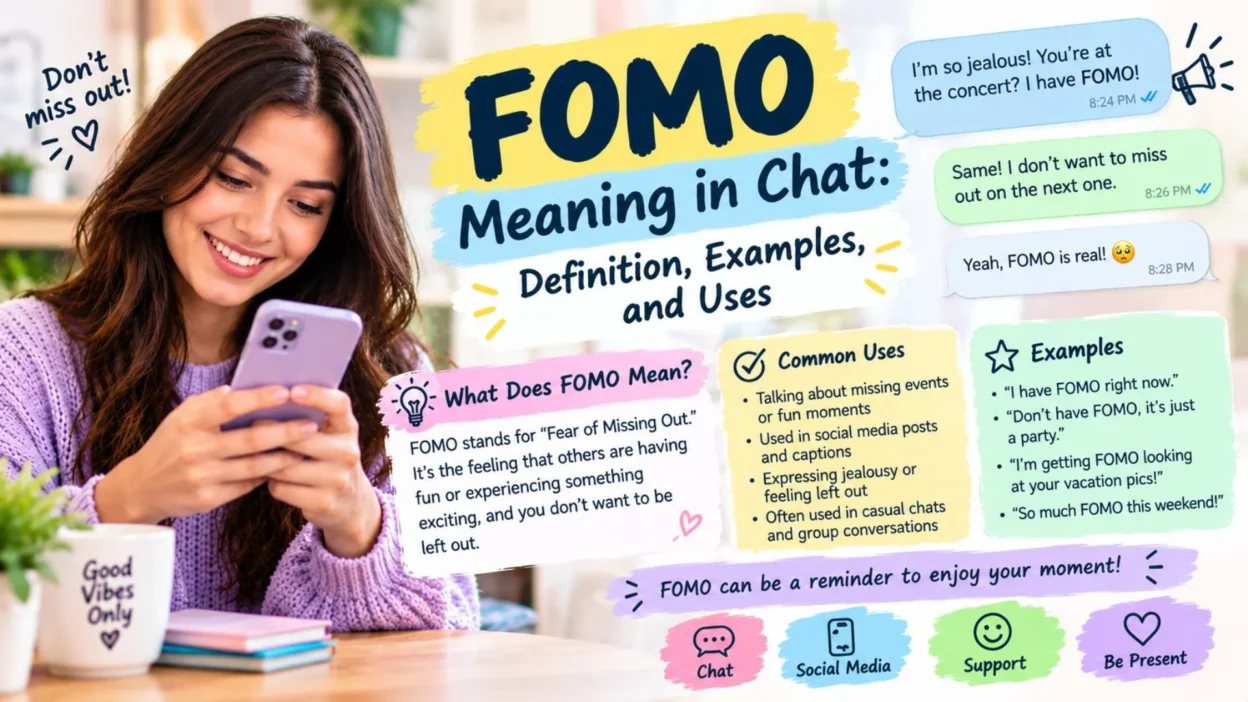
FOMO meaning in chat is “Fear of Missing Out.” People use this popular internet slang when they feel worried about missing an exciting event, a fun activity, an important update, or an experience everyone else seems to enjoy. It often appears in text messages, social media comments, group chats, and online conversations.
For example, if your friends go to a party without you, you might text, “I have serious FOMO right now!” This means you wish you were there and feel like you are missing something fun.
FOMO is common among teenagers, friends, social media users, and people who follow online trends. It can describe anything from missing a birthday party to watching everyone discuss a trending topic you have not seen yet. However, the meaning can change slightly depending on the conversation.
In this guide, you will learn what FOMO means in texting, how people use it, and how to reply when someone sends it. You will also discover real-life examples, similar slang terms, and common mistakes to avoid when using FOMO in chat.
📱 What Does FOMO Mean in Chat?
FOMO stands for Fear of Missing Out. It describes the feeling that other people are enjoying something interesting while you are not included.
In everyday texting, people often use FOMO casually. They might feel left out because friends are hanging out, classmates are attending an event, or everyone online is talking about something exciting.
Here are a few situations where someone might use FOMO:
- 🎉 Your friends attend a party, but you cannot go.
- 📸 You see pictures of your friends enjoying a weekend trip.
- 🎮 Your gaming friends start a match without you.
- 🍿 Everyone watches a popular movie before you.
- 🎤 Your favorite singer announces a concert in your city.
- 💬 Your group chat discusses an inside joke you do not understand.
FOMO does not always mean someone feels deeply upset. Sometimes, it simply expresses playful jealousy or a wish to join the fun.
For example:
Friend: “We had so much fun at the beach yesterday!”
You: “Stop posting pictures! You’re giving me FOMO 😂”
In this conversation, FOMO means the pictures make you wish you had joined your friends.
💬 How Is FOMO Used in Text Messages?
People use FOMO in different ways depending on the situation, their relationship, and the tone of the conversation. It can express excitement, regret, curiosity, or a lighthearted feeling of being left out.
Common uses include:
- Missing an event: “I have FOMO because I couldn’t attend the concert.”
- Reacting to photos: “These vacation pictures are giving me FOMO!”
- Joining a trend: “Everyone is trying that new game. I have FOMO.”
- Talking about plans: “I might come tonight because I don’t want to miss out.”
- Joking with friends: “You guys went out without me? FOMO is real 😂”
- Following online discussions: “I need to watch that show before I get more FOMO.”
FOMO also appears as a noun in everyday conversation. Someone might say, “My FOMO made me buy a ticket,” meaning they bought the ticket because they did not want to miss the experience.
Although the phrase originally describes a feeling, people now use it broadly for situations where they want to participate in something others are enjoying.
😂 Real Examples of FOMO in Chat
The easiest way to understand FOMO is to see how it appears in actual conversations. These examples show how friends might use the slang naturally.
Example: Missing a Party
Alex: “Everyone is at Mia’s birthday party!”
Sam: “I know 😭 I have major FOMO.”
Here, Sam feels disappointed about missing a social event.
Example: Seeing Vacation Pictures
Friend: “Look at these pictures from our trip!”
You: “Wow, instant FOMO. That place looks amazing!”
The pictures make you wish you had experienced the trip too.
Example: Missing a Game Night
Jordan: “We played games until midnight yesterday.”
Taylor: “Without me? That’s FOMO material 😂”
Taylor uses FOMO playfully because the group had fun without them.
Example: Following a Trend
Friend: “Have you watched the new series everyone is talking about?”
You: “Not yet. I’m getting FOMO because I can’t follow the conversations.”
This example shows how FOMO can happen when you feel left out of a popular discussion.
Example: Deciding Whether to Attend
Friend: “Are you coming to the festival?”
You: “Probably! I don’t want to have FOMO when everyone shares their pictures.”
The person wants to attend because they do not want to miss the experience.
🧠 What Does FOMO Mean on Social Media?
On social media, FOMO usually describes the feeling of missing exciting experiences that other people share online.
Platforms such as Instagram, TikTok, Snapchat, and Facebook make it easy to see photos, videos, and updates about other people’s activities. These posts can make someone wish they were included.
For example, you might see friends posting concert videos, restaurant visits, shopping trips, or weekend adventures. Their posts may make you feel that everyone is having fun without you.
Common social media uses include:
- 📷 “These Instagram stories are giving me FOMO.”
- 🎶 “Everyone is at the concert, and I’m stuck at home.”
- ✈️ “My entire feed is vacations. Major FOMO!”
- 🛍️ “Everyone bought the new collection before it sold out.”
- 🎬 “The whole internet is talking about this movie, and I haven’t watched it.”
However, social media usually shows selected moments rather than someone’s entire life. A person might share their happiest experiences without showing the ordinary or difficult parts of their day.
Therefore, feeling FOMO after seeing a post does not necessarily mean someone else has a better life. It may simply mean the experience looks appealing.
❤️ What Does FOMO Mean in a Relationship?
In relationships, FOMO can describe the feeling of missing out on experiences with a partner or worrying about being excluded from their social life.
For example, someone might feel FOMO when their partner attends a gathering without them or when friends share pictures of couples spending time together.
Here are some examples:
- “You went on a date night without telling me? I have FOMO!”
- “Everyone is posting anniversary pictures, and now I want a special date too.”
- “I got FOMO when I saw you all hanging out yesterday.”
- “Let’s plan a weekend trip. I don’t want to miss all the fun.”
The meaning depends on the context. Sometimes, FOMO is simply a playful comment. In other situations, it may reflect a genuine desire to spend more time together.
It is important not to assume that every expression of FOMO indicates jealousy or insecurity. A person may just want to participate in an enjoyable experience.
Clear communication can help when the feeling involves repeated exclusion or unmet expectations.
🔍 What Is the Difference Between FOMO and JOMO?
FOMO and JOMO describe opposite attitudes toward missing experiences.
FOMO means Fear of Missing Out, while JOMO means Joy of Missing Out. JOMO describes feeling happy or peaceful about skipping an activity and enjoying your own time instead.
| Term | Full form | Meaning |
|---|---|---|
| FOMO | Fear of Missing Out | Worrying that you are missing something enjoyable |
| JOMO | Joy of Missing Out | Feeling content about not joining an activity |
Here are examples of both terms:
- FOMO: “Everyone is going out tonight, and I wish I could join them.”
- JOMO: “Everyone is going out tonight, but I’m happy staying home and relaxing.”
FOMO often focuses on experiences you are not having. In contrast, JOMO focuses on appreciating the experience you choose for yourself.
Neither term is automatically good or bad. It depends on the situation and how you feel about your choices.
🤔 What Does It Mean When Someone Says “I Have FOMO”?
When someone says, “I have FOMO,” they usually mean they feel they are missing something interesting or enjoyable.
The exact meaning depends on what you were discussing before they sent the message.
For example:
- After a party: They wish they had attended.
- After seeing a trip: They wish they could have joined.
- During a trending discussion: They want to understand what everyone is talking about.
- When friends make plans: They want to be included.
- When shopping: They worry about missing a popular product or limited-time offer.
Consider this conversation:
You: “We’re going bowling tomorrow. Want to come?”
Friend: “Definitely! I had FOMO after seeing your last bowling pictures.”
Your friend means they wished they had joined the previous outing and want to participate this time.
In most casual chats, FOMO is not a complicated expression. It simply communicates that someone does not want to miss a fun or meaningful experience.
✍️ How to Reply When Someone Texts FOMO
Your response can be friendly, funny, reassuring, or inviting. Choose one that fits the situation and your relationship with the person.
Here are some natural replies:
Friendly replies
- “You should come next time!”
- “We’ll make sure you’re included next time.”
- “Wish you could’ve been there!”
- “Let’s plan something together soon.”
Funny replies
- “FOMO level: 100 😂”
- “Your invitation is waiting for the next adventure!”
- “Don’t worry, more fun is coming.”
- “We saved the best stories for you 😂”
If they missed an event
- “You were definitely missed!”
- “It would’ve been more fun with you.”
- “Next time, we’re going together.”
- “I’ll send you all the pictures.”
If they feel left out
- “I’m sorry you couldn’t join us.”
- “Let’s arrange a day that works for everyone.”
- “You can always tell us when you want to join.”
- “Let’s make plans soon!”
A simple reply is usually enough. You do not need to make the conversation complicated just because someone uses an acronym.
🌐 Is FOMO Positive or Negative?
FOMO can be positive or negative depending on the situation.
Sometimes, it motivates people to try new activities, attend events, meet friends, or explore new interests. For example, seeing friends enjoy a hiking trip might encourage someone to join their next outdoor adventure.
However, FOMO can also make people feel pressured to participate in everything. Constantly comparing your experiences with other people’s social media posts may leave you feeling dissatisfied with your own plans.
Here are a few ways FOMO can affect everyday life:
- Positive motivation: It encourages someone to try a new hobby or attend an event.
- Social connection: It reminds someone that they want to spend more time with friends.
- Unnecessary pressure: It makes someone feel they must attend every gathering.
- Online comparison: It creates unrealistic expectations about how much fun everyone else is having.
- Impulsive decisions: It may encourage someone to spend money or make plans without thinking carefully.
If FOMO makes you feel pressured, remember that you do not have to join every event or follow every trend. Choose activities that fit your interests, budget, schedule, and comfort.
📲 Why Is FOMO So Popular in Online Conversations?
FOMO became popular because it describes a feeling that many people recognize. Modern communication makes it easy to see what friends, celebrities, and online communities are doing throughout the day.
The acronym is also short, easy to type, and widely understood in informal conversations.
Several factors contribute to its popularity:
- Quick communication: Four letters express a complete idea.
- Social media updates: Photos and videos often show exciting activities.
- Trending topics: People want to understand popular conversations.
- Group chats: Friends use FOMO to talk about events they missed.
- Internet culture: Memes and jokes make the term easy to recognize.
- Shared experiences: Many people understand the feeling of wanting to join something fun.
FOMO is not limited to one age group or platform. People use it in everyday conversation, online discussions, and sometimes professional settings.
However, it is generally more suitable for informal communication than formal reports or academic writing.
⚠️ Common Mistakes When Using FOMO
Although FOMO is easy to understand, a few mistakes can cause confusion.
- Using the wrong full form: FOMO means “Fear of Missing Out,” not “Feeling of Missing Out.”
- Assuming it always means jealousy: Someone may simply want to join an activity.
- Treating every use seriously: Friends often use FOMO as a joke.
- Confusing it with JOMO: JOMO describes enjoying the decision to miss out.
- Using it in every sentence: Like other slang, FOMO sounds more natural when used where it fits.
- Assuming everyone knows the acronym: In formal or unfamiliar settings, spelling out the phrase may be clearer.
For example, “I’m experiencing FOMO about the concert” is understandable, while “I have FOMO because I wanted to attend the concert” makes the meaning especially clear.
Use the term naturally, and pay attention to the surrounding conversation.
❓ Frequently Asked Questions About FOMO Meaning in Chat
What does FOMO stand for in texting?
FOMO stands for “Fear of Missing Out.” It describes the feeling that you are missing an enjoyable event, activity, trend, or experience.
What does FOMO mean on Instagram?
On Instagram, FOMO usually describes wishing you could join an experience after seeing someone else’s stories, photos, or videos.
What does “FOMO is real” mean?
“FOMO is real” means someone genuinely feels they are missing out on something enjoyable. People also use the phrase humorously when reacting to friends’ plans or social media posts.
Is FOMO slang or an abbreviation?
FOMO is an acronym that has become common internet slang. Its letters represent the words “Fear of Missing Out.”
What is the opposite of FOMO?
JOMO, meaning “Joy of Missing Out,” is commonly considered the opposite of FOMO. It describes feeling content about skipping an event or choosing to spend time differently.
Can I use FOMO in a professional message?
You can use FOMO in informal workplace chats when the audience understands the term. In formal emails or reports, writing “fear of missing out” is usually clearer.
Does FOMO mean someone is jealous?
Not necessarily. FOMO can involve jealousy, but it often simply means someone wishes they could participate in an activity or experience.
✅ Conclusion
Understanding FOMO meaning in chat is simple: it stands for “Fear of Missing Out” and describes the feeling of missing an exciting experience that others are enjoying. People commonly use FOMO in text messages, group chats, relationships, and social media conversations. Whether someone is reacting to party pictures, a trending topic, or a friend’s vacation, the term helps express that they wish they could join the fun. Use it naturally, and remember that missing one experience does not mean you are missing out on everything.

Logan Reed is a humor writer and digital content creator at Punesty, passionate about crafting funny puns, witty jokes, clever one-liners, and entertaining pick-up lines. With a love for internet humor and creative wordplay, Logan creates content designed to make people laugh, smile, and brighten their day. When he’s not writing new jokes, he enjoys exploring trending memes, pop culture humor, and viral online entertainment.